Philia: A Glimpse into Long-term Physical Coexistence with Intelligent Robots
Technical ReportPhilia is an agentic runtime system that enables intelligent robots to serve as long-term assistants rather than isolated task executors. By decoupling semantic reasoning from robot execution, Philia allows multiple heterogeneous robots to share a single assistant identity while remaining safe, extensible, and continuously improvable.
In our view, robots should not be limited to executing individual skills; instead, they are positioned to act as persistent user-facing assistants. To facilitate long-term human–robot coexistence, Philia integrates the following core capabilities:
- Long-term memory of people and preferences
- Natural interaction across voice, chat, and web
- Control across multiple robot embodiments
- Semantic navigation and spatial understanding
- Safe and auditable physical execution
The result is a persistent robotic assistant that understands context, remembers users, and performs real-world tasks over extended interactions.
Architecture
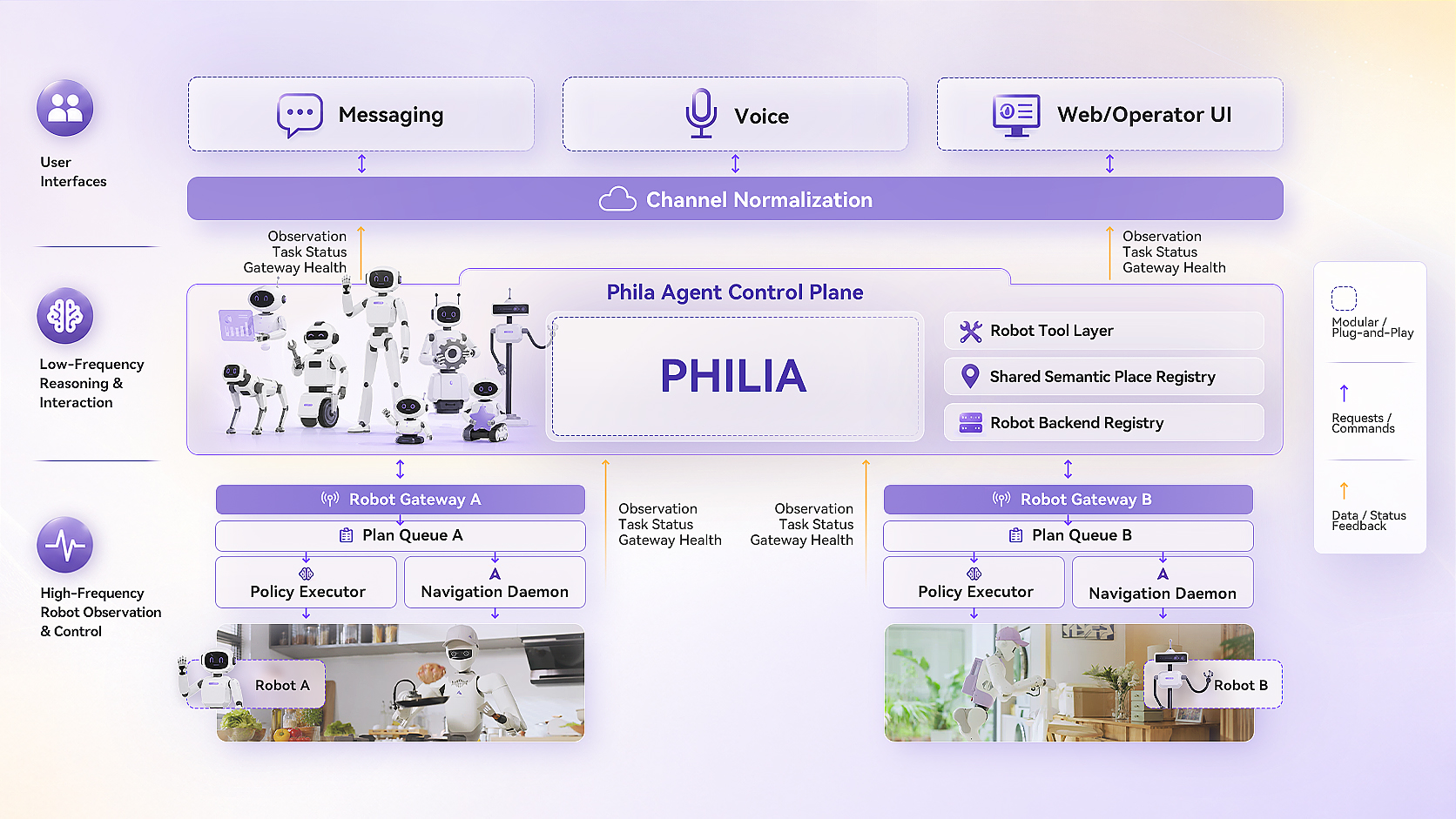
Philia adopts a three-layer hierarchical architecture. The explicit layer separation decouples high-level assistant intelligence from low-level robot execution, enabling independent and continuous evolution of agent capabilities and robot runtimes.
User Interfaces
Supports human interaction through instant messaging, voice dialogue, and web applications.
Agent Control Plane
Serves as the core of the persistent robotic assistant, this layer handles:
- User intent understanding
- Long-term memory and personalized user management
- Task planning and execution scheduling
- Multi-robot control and scheduling
- System safety control and access authorization
Robot Gateways
Individual robots expose unified functional capabilities, including environmental perception, navigation and localization, physical manipulation, speech interaction, and real-time status monitoring. This layer encapsulates robot-specific middleware and low-level control systems.
Core Design Principles
Compositional Intelligence
Philia is built on a fully modular architecture with decoupled subsystems. Improvements to any single component can directly enhance the overall capability of the system, including user interfaces, reasoning models, memory systems, navigation algorithms, manipulation policies, and support for new robot embodiments. No end-to-end system redesign is required for incremental upgrades.
Memory-Grounded Assistance
Philia maintains persistent semantic memory covering four categories: user preferences, historical interactions, task execution history, and semantic location information. Memory is only used to assist task planning, not to directly control robot execution. This design enables personalized behavior adaptation while ensuring execution safety through the gateway layer.
One Agent, Multi-Robot Control
Multiple robots can operate simultaneously as different physical embodiments of a single intelligent assistant. Philia handles robot assignment, semantic space sharing, capability matching, and multi-robot task scheduling. Each robot retains its own mapping, localization, and runtime environment while sharing a unified semantic space, enabling efficient control across heterogeneous robots.
Safety by Design
All physical actions must pass through explicit execution gate checks, including authorization verification, user confirmation, robot readiness check, task arbitration, and actor-scoped stop/cancel mechanisms. This design preserves the flexibility of natural language interaction while ensuring the safety and auditability of physical execution.
Vision
Philia redefines the role of robots: from isolated functional machines to persistent intelligent assistants. By decoupling agent intelligence from robot execution via standardized capability interfaces, Philia provides a scalable system framework where advances in AI, robotics, user interfaces, and interaction paradigms can accumulate continuously, advancing the realization of long-term physical coexistence between humans and intelligent robots.